Image modified from Mathews & Tremonte 2012 depicts evolution of phytochrome-controlled far-red high irradiance response in seed plants.
Phytochrome evolution
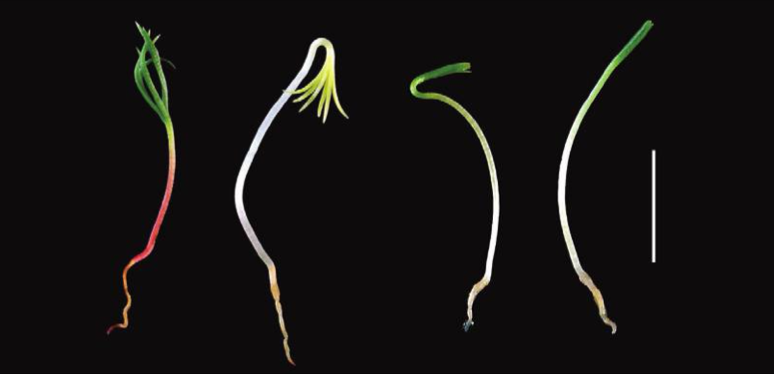
Seedlings of the conifer, larch (Larix laricina), grown in continuous white light, dark, far-red, or red light, showing that seedling light responses in some conifers are like those of a flowering plant seedlings. *Donna Tremonte photos

PHYTOCHROME EVOLUTION
Phytochrome photoreceptors enable plants to detect neighbors and to determine whether they are in open or shaded environments through their capacity to measure the ratio of red to far-red light in their environment. Land plants inherited a single phytochrome gene from their algal ancestors, which over the course of land plant evolution, independently diversified into small gene families, once each in mosses, ferns, and seed plants. In seed plants, divergence of gene duplicates led to two distinct functional types that have complementary and antagonistic roles in open versus shaded environments. One of our research goals is to use phylogenetic insights to design functional experiments that test whether divergence in phytochrome function helped plants better adapt to canopy shade.