Australasian Showy Mistletoes

Amylotheca dictyophleba at la baie d’Oro, L'Île-des-Pins, New Caledonia. S Mathews photo.

Showy mistletoes are obligate parasites. Their level of host specificity therefore influences the extent of their 1) geographic range and their capacity for range shifts in response to environmental change; 2) dispersal routes; 3) local abundance; 4) likelihood of population persistence; and 5) the set of organisms with which they interact.
Most Loranthaceae use multiple species of hosts, but some are clear generalists, while others show specificity at various phylogenetic scales, from the level of major flowering plant clade to genus-level specificity. Our work so far, focused on the Australian showy mistletoes, has revealed that mistletoes were most commonly reported on hosts in the rosid clade of flowering plants, suggesting that relationships of mistletoes with rainforest lineages may have been established early in the history of Australian Loranthaceae and that some lineages co‐diversified with their hosts in arid regions (Santiago-Rosario et al. 2024).
RIGHT: Summary bipartite networks of mistletoe species interactions with their host orders for (A) Amyema, (B) Amylotheca, (C) Decaisnina, (D) Dendrophthoe, (E) Lysiana, and (F) Muellerina. Mistletoe species are shown in the top half of each circle and records of host orders are shown at the bottom half of each circle. Host orders are colored by clades with asterid orders in hues of red, rosids hues of blue, basal eudicots hues of yellow, magnoliids hues of green, and conifers hues of brown. Dilleniales and Santalales were assigned single colors, orange, and lime green, respectively . Ticks indicate increments in the number of observations and differ by mistletoe genus.
Host Specificity
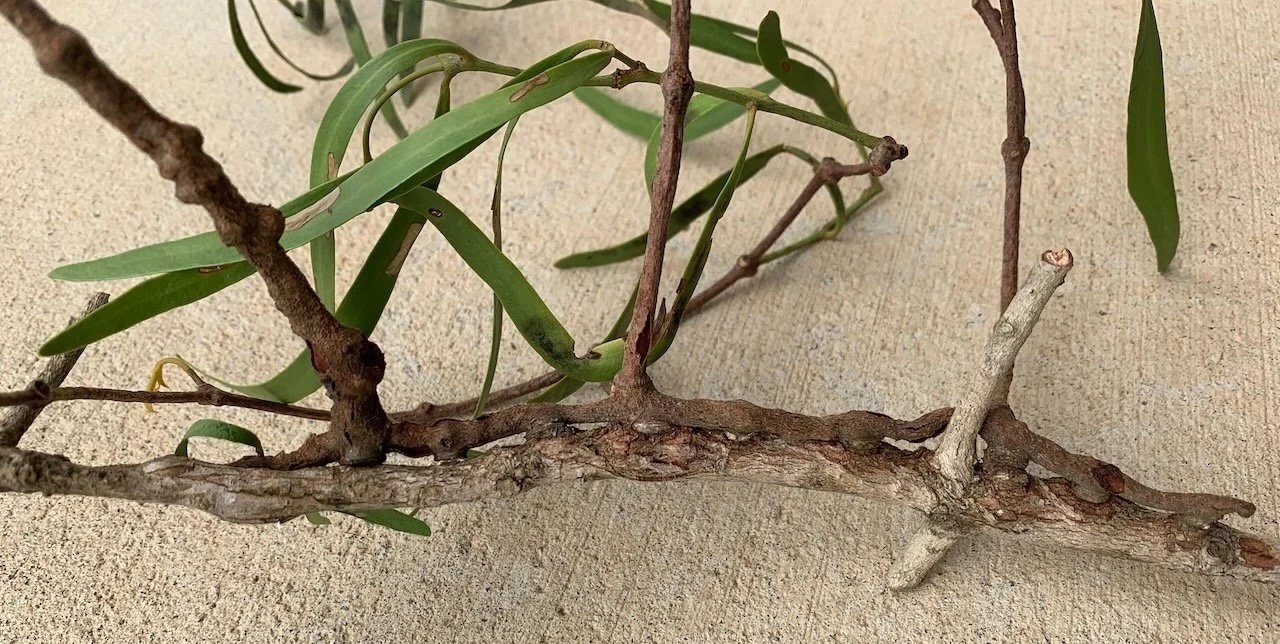
Mistletoe (Decaisnina brittenii) attached to host stem via multiple haustoria. S Mathews photo.
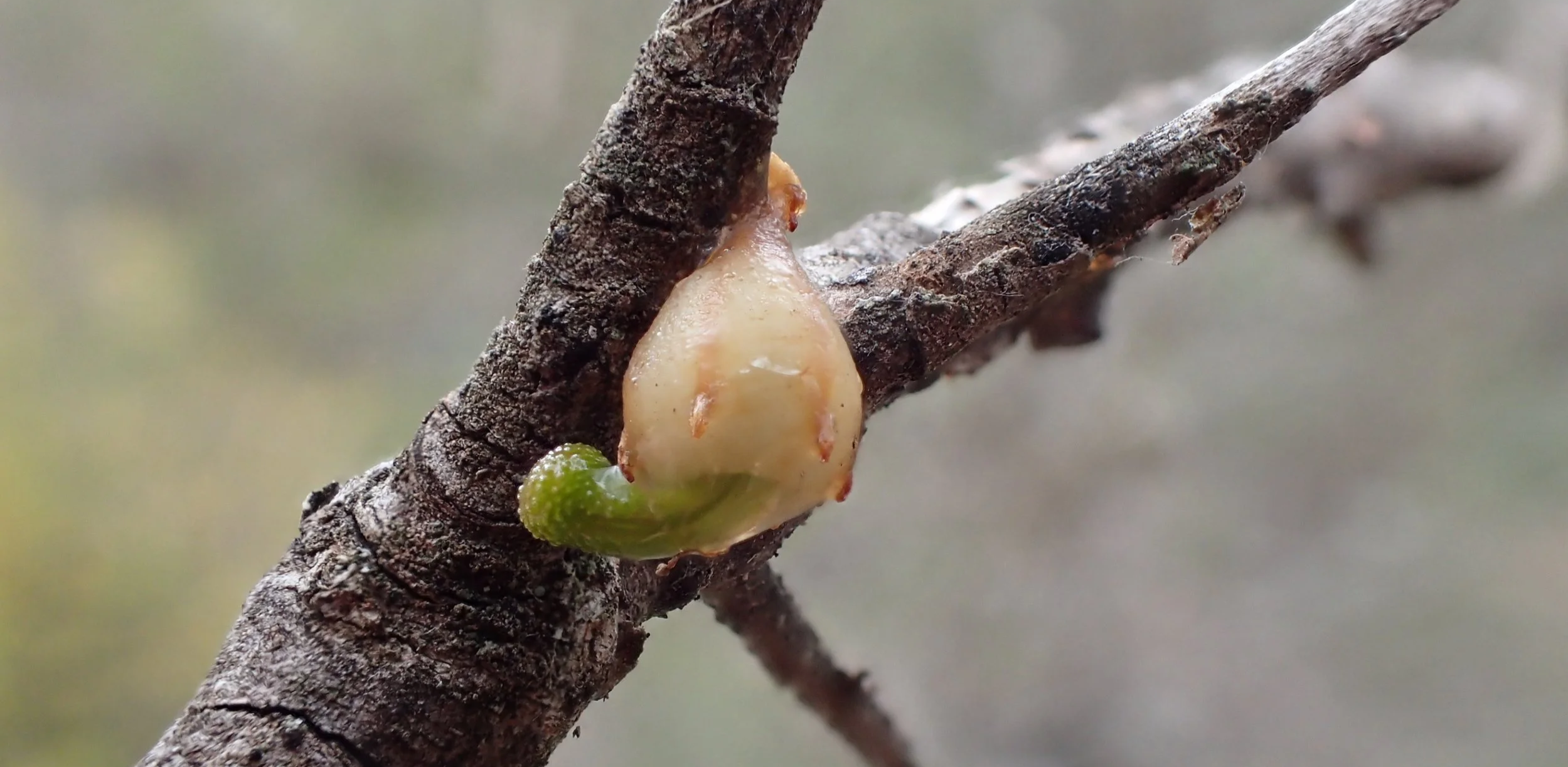
Mistletoe (Amyema cambagei) germinant. K Harms photo.
Mistletoe interactions - organisms, traits, and the environment
Adult Imperial Jezebel (Delias harpalyce) emerging from chrysalis on mistletoe (Amyema pendula). S Mathews video.
Mistletoes in Loranthaceae support diverse mutualists through their production of nectar-rich flowers and lipid-rich fruits, are the food source for numerous insects, including many specialist lepidopterans, and are preferred nesting sites of many vertebrates. They have unusually long reproductive phases and in some communities, they provide fruit and/or nectar throughout the year. Their role as facilitators that increase biodiversity and productivity has been demonstrated in communities in Africa and Australia and is based on their production of abundant and nutritious leaf litter.
Mistletoes, their hosts, and their diverse interacting partners provide an especially good system for the study of evolutionary and ecological processes that contribute to biodiversity and its maintenance. Phylogenetic trees of mistletoes and their main partners are helping us discover the biogeographic origins of mistletoes and their partners, studies of their traits are helping us discover processes that mediate the success of these partnerships, and studies of their spatial distributions are helping us discover environmental variables that constrain their presence or absence in a community.
Reach out if you would like to participate!
Mistletoe-host chemistry
It has been said that “mistletoes are what they eat”. This implies that levels of chemical elements in a mistletoe and its host are the same. This would rarely be true, except in cannibals. Most studies have found that there is a mismatch in at least some elements between mistletoes and their hosts. We took the question a bit further and asked 1) whether there was evidence that mistletoes hold some chemicals at a certain level, despite variation in element concentrations across different hosts (homeostatic regulation), and 2) whether mistletoes over or under accumulate any elements relative to their hosts. This allowed us to highlight consistent imbalances between a mistletoe and its host that might, and provide insights into, their distinctive life history traits, such as extended reproductive phenology and high transpiration rates. At broader scales, stoichiometric mismatches between mistletoes and hosts may influence herbivore foraging, shape plant–animal interactions, and alter nutrient inputs through litterfall, thereby contributing to ecosystem productivity and biodiversity.
Read about the study here: https://esajournals.onlinelibrary.wiley.com/doi/10.1002/ecs2.70717